
Lowell Program Topics on Ore Deposits Mapping
An extended field and mapping course through the Great Basin exploring diverse ore-forming systems in their regional context. Students apply detailed “Anaconda-style” mapping methods—focusing on the Yerington district and other notable deposits—to interpret mineral zoning, system evolution, and hydrothermal alteration. Designed for graduate students in Economic Geology, with limited seats available for industry and other professionals.
This course is offered from September 2nd through September 13th, 2026. Do you want to join the waiting list? Send us an email:
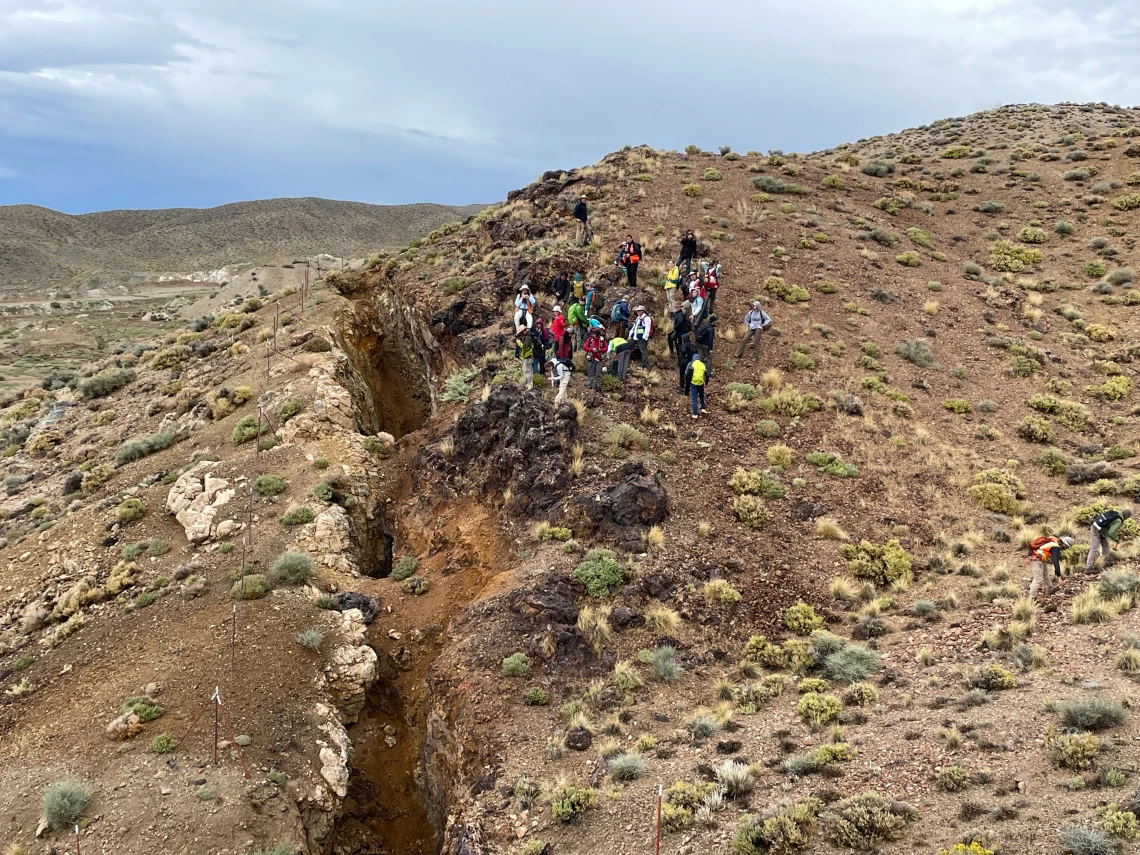
As part of the University of Arizona’s advanced ore deposits curriculum (course no. GEOS 504B), Mark Barton with help from JD Mizer and Eric Seedorff, lead an extended field trip and mapping course through the Great Basin. Themes include the broader context of ore-forming systems and how to look at them in the field at multiple scales. It is an opportunity to see ore deposits of various types and ages in the context of the region's structural, magmatic, and fluid evolution. The trip is designed for graduate students taking an advanced ore deposits class, but we reserve approximately 25 seats for industry members and other professionals. Most non-UA participants meet in Las Vegas, although joining for the Tucson-Las Vegas drive (with geology) is possible.
Course Details
The trip includes a focused multi-day introduction to the “Anaconda-style” of detailed mapping as applied to multiple deposit types, with a focus on the Yerington district in Nevada. Although the Yerington focus is on porphyry copper and skarn mineralization, the mapping method is adaptable to any type of mineral system. As part of this, we highlight how mapping can be used to understand zoning, the time-space evolution of mineralizing systems, and the relationships to the fundamental phase equilibria of hydrothermal alteration. In addition to numerous other geologic stops, the trip is also expected to include overviews and/or tours of the following districts and deposits:
- Colorado River corridor, Arizona [pre-LV, detachment IOCG]
- Oatman, Arizona [pre-LV, low-sulfidation epithermal Au]
- Goldfield, Nevada [high-sulfidation epithermal Au],
- Tonopah, Nevada [low-sulfidation epithermal Ag-Au],
- Birch Creek, California [granite emplacement, F-Be-W-(Zn) greisen/skarn],
- Long Valley – Mono Lake, California [contrasting modern volcanic and geothermal systems]
- Humboldt/Carson Sinks, Nevada [active faulting and modern amagmatic geothermal systems]
- Humboldt, Nevada [IOCG occurrences],
- Eureka district, Nevada [partially superimposed systems, with Carlin-type Au mines at Windfall, Rustler, and Archimedes, a porphyry Mo-Cu to replacement Zn-Pb-Ag deposit at Ruby Hill, and the top of a F-W-Zn-Be- (Mo-Sn) system at McCullough Butte]
- Robinson district, Nevada [porphyry Cu-(Mo-Au) and related skarn and distal Au-Ag deposits].
UA Students, please find more information about this course in the course catalog: GEOS 504B.
Format and logistics
The trip is a 10-day round trip from Las Vegas, covering about 2,500 miles in 4WD vehicles. Industry participants should plan to arrive in Las Vegas no later than Wednesday evening, as the trip leaves early on Thursday morning. Industry participants should plan to depart from Las Vegas no earlier than Saturday.
Pricing
Registration cost for non-university participants is US $ 3,900 (before the early registration deadline) and $4,100 (after the early registration deadline)
This includes ground transportation, all lunches in the field, double-occupancy accommodations in motels each night during the trip, and course materials. Breakfasts and most dinners are the responsibility of participants. Industry participants must also provide transportation to and from Las Vegas and their accommodations the night before and after the trip.
Information for non-US residents
Non-US residents or citizens who want to participate in the short course must have a US visa or check whether they are eligible for an ESTA. If you have to apply for a U.S. visa to enter the U.S, we work with you to ensure you have the necessary documents for your application. Please note that we do not initiate visa applications.
During the course, you will be asked to sign a “Statement of Honoraria Recipients” (used in association with expenses associated with the activities of foreign visitors who come to the US on visa types B1/B2 and WB/WT). We will also make a photocopy of your passport page showing the photograph and expiration date, and the passport page showing the visa, or alternatively, Mexican Border Crossing Card (Nationals of countries that participate in the “US visa waiver program” do not need a visa to enter the US).